
Alachua County Directory Shelves
The Alachua County Library District genealogy collection identifies the surviving local runs by title and year. Headquarters combines print, microfilm, and licensed databases. Some years are missing, so a range describes the shelf rather than a promise of one volume for every year.
| Collection | Years | Where Held | Access |
|---|---|---|---|
| Coy City Directory and Guide | 1934-1935 | ACLD Headquarters | Print or microfilm; eight county cities |
| Polk Gainesville City Directory | 1938-current, gaps | ACLD Headquarters | Print or microfilm |
| Miller's Gainesville Directory | 1938-1954 | ACLD Headquarters | Print; compare with Polk |
| Streets and Numbers directory | 1950 | ACLD Headquarters | Address-keyed reference |
| Hill-Donnelly Cross Reference | 1969-current, gaps | ACLD Headquarters | Reverse street search |
| Gainesville telephone books | 1907-2011, gaps | ACLD Headquarters | Print or microfilm |
| Southern Bell directory | 1899 | ACLD and Matheson digital documents | Digitized local document |
The Coy directory reaches beyond Gainesville to Alachua, Archer, Hawthorne, High Springs, Micanopy, Newberry, and Waldo. That countywide scope makes it distinct from later Gainesville-centered books. The overlapping Polk and Miller years are valuable checks when a name is missing or abbreviated differently.
Use Alachua Directory Microfilm
Reference materials do not circulate, but ACLD can route a physical non-microform reference item to another branch for in-library use after a reader speaks with staff. Headquarters has both 35mm and 16mm readers. Pages may be printed or saved to a patron-supplied USB drive.
Photograph or save the title page, publication year, abbreviation key, entry, and adjacent page numbers. That context prevents an isolated initial or symbol from becoming a false match. The genealogy librarian or reference desk is the best fallback for a missing year, an unclear reel, or a title that the online inventory lists without a direct scan.
Note: A directory range may contain gaps; record the exact volume consulted rather than assuming annual publication.
Alachua's Layered Directory Years
The local sequence changes shape over time. It begins with a Southern Bell book, expands through telephone books, adds two overlapping publishers in the late 1930s, gains a street-number volume in mid-century, and becomes address-first through Hill-Donnelly. Each change opens a different search direction.
| Year | Directory milestone |
|---|---|
| 1899 | Southern Bell local directory survives digitally |
| 1907 | Long Gainesville telephone-directory run begins |
| 1934 | Coy countywide city directory run begins |
| 1938 | Polk and Miller Gainesville runs overlap |
| 1950 | Streets and Numbers volume provides an address bridge |
| 1969 | Hill-Donnelly reverse-directory run begins |
This layered shelf allows both a name-to-address search and an address-to-name search. It also explains why one catalog title cannot stand in for the whole Alachua County city directory collection.
Read Alachua City Directory Entries
Coy, Polk, Miller, and Hill-Donnelly did not use one fixed layout. An alphabetical entry may give a surname, initials, spouse, occupation or employer, and residence. Later reverse volumes start with street and house number. Always read the key printed in that edition before expanding a mark.
| Name | Surname and given name or initials, copied exactly |
|---|---|
| Spouse or widow | A spouse in parentheses or a widow notation where included |
| Work | Occupation, employer, or business affiliation |
| Residence | House number and street, kept separate from a business address |
| Telephone | Subscriber number in telephone and cross-reference years |
| Citation | Year, title, publisher, page, and image reference |
- Criss-cross directory
- An address-first book arranged by street and house number.
- Householder index
- A list centered on the named person responsible for a household entry, not every occupant.
- Abbreviation key
- The publisher's own legend for marks such as residence, boards, employed, and widow.
A missing name may reflect an unlisted telephone, a renter or boarder omitted by the survey, a move after canvassing, or a missing volume. It does not show that a property stood vacant.
Fill Alachua Directory Gaps
The Gainesville Sun supplies two complementary tracks. Headquarters holds microfilm from 1865 through 2018 with some missing dates, while the Gainesville Sun Collection offers full-color images from 1911 onward and a text-only layer for 1995 through 2018. Search both. OCR can miss a name, and the text layer may hold content absent from an image search.
High Springs research has its own newspaper line through the High Springs Herald microfilm for 1952 through 1996. Digitized Gainesville High School yearbooks add class names, portraits, clubs, and school ties. The Florida Digital Newspaper Library provides free searchable text and zoomable images for broader Florida newspaper work.
Obituaries and announcements can explain why a directory name disappears. They can also distinguish two people who share initials.
Alachua Community Archives Add Voices
The University of Florida Special and Area Studies Collections adds finding aids, manuscripts, maps, photographs, and oral histories. The African American History in Alachua County Collection covers 1975 through 2021. The Joel Buchanan Archive holds nearly 700 oral histories of Black life in Florida and the Gulf South. These sources can restore names, organizations, and lived context that property and published directory indexes omit.
The Matheson History Museum Library and Archives, at 418 E University Avenue, holds county subject files, civic and social group records, photographs from the 1920s through the 1950s, postcards, and stereoviews. Access is by appointment, not walk-in or same-day service. Because its online catalog represents only a small share of the holdings, contact staff before planning research.
Yearbooks, directory addresses, and obituary notices can reconnect a historical school or community identity without claiming a present address.
Map an Alachua Directory Address
UF's Sanborn collection shows street names, lot lines, house and block numbers, and building information. Match the directory year to the nearest map sheet, then watch for changed numbers or names. The 1949 Gainesville City Engineer map offers another mid-century view of urban development.
Pleasant Street shows why several sources matter. Gainesville tax records do not precede 1891, Sanborn coverage begins only in part in 1897 and becomes fuller in 1903, and some deed chains do not date early buildings well. A directory entry, plat, deed, and series of Sanborn sheets can provide a cumulative answer where no single source can.
Connect Alachua Names to Records
After a name and address appear in a volume, the Alachua Clerk Historical Records archive can extend the trail through deeds, marriage, probate, census maps, and volunteer transcriptions.
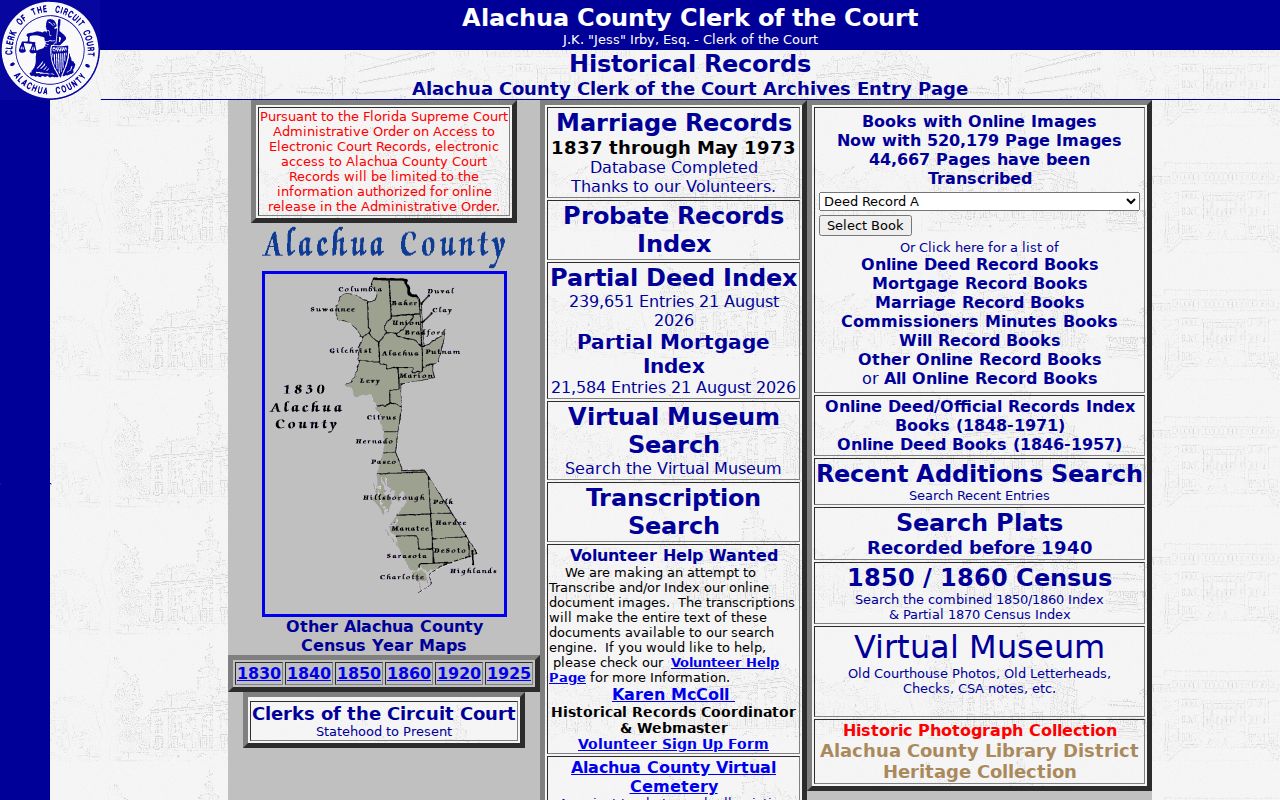
The archive is separate from the modern Official Records portal. It includes deed books from 1846, deed index books from 1848, and a completed marriage database through May 1973, so a modern cutoff is not the start of the county record trail.
Search women under birth and married surnames, and try initials. The Clerk also advises searching organizations or trusts as indexed and removing a middle initial when an exact form suppresses a match.
Trace Families in Alachua Directories
City directories fill the years between decennial federal censuses. Public population schedules currently extend through 1950 under the 72-year rule. A directory may show movement and work from year to year, while the census can supply ages and household relationships that a directory usually omits.
- Find the person's first likely appearance in the alphabetical volume nearest the target year. Copy the spelling, initials, work, address, and citation.
- Check the prior and next available editions. Mark shelf gaps instead of assuming that adjacent volumes represent adjacent years.
- Use the 1950 Streets and Numbers book or a Hill-Donnelly volume to reverse the address and inspect listed neighbors.
- Pair a directory before and after a census year with the matching federal schedule. Keep the historical county boundary in mind.
- Extend the trail with newspapers, probate, deeds, Evergreen Cemetery records, or yearbooks, depending on what the directory suggests.
Disappearance is a question, not a conclusion. Search the next directory under another surname or initial, inspect an obituary and newspaper window, and check a deed or probate file. For the missing 1890 federal population schedules, bridge 1880 to 1900 with tax, deed, newspaper, church, cemetery, and directory evidence.